When a clinic, hospital wing, or nursing home in Killeen floods, catches fire, or suffers a sewage backup, the stakes look nothing like a typical residential job. A homeowner can usually wait a day or two for repairs without serious consequences. A healthcare facility cannot. Patients with compromised immune systems, sensitive medical equipment, strict regulatory requirements, and 24/7 operational demands all raise the bar for what “cleanup” actually means.
That’s the core difference between standard water damage restoration and true healthcare facility restoration: it’s not just about drying out a room and replacing drywall. It’s about doing that work in a way that protects vulnerable patients, satisfies infection-control standards, and gets a facility back to full operation without a single day of unnecessary downtime.
Here’s what actually sets medical-grade cleanup apart, and why choosing the right restoration partner matters more in a healthcare setting than almost anywhere else.
1. Infection Control Isn’t Optional – It’s the Whole Job
In a typical home, a restoration crew’s main concern is moisture and mold. In a hospital, clinic, or nursing home, water intrusion and structural damage create a much bigger risk: airborne and surface-based pathogen spread. Standing water and damp materials are a breeding ground for bacteria, and in a building full of immunocompromised patients, that’s a serious problem.
Medical-grade restoration teams treat every job with the same discipline used in virus and bacteria disinfection work – using hospital-grade disinfectants, controlled airflow, and containment barriers to stop contamination from spreading to occupied areas of the building. This isn’t an add-on service; it’s baked into the process from the first hour of response.
2. Containment Has to Protect Patients, Not Just the Work Area
On a residential job, containment barriers keep dust and debris out of the rest of the house. In a healthcare facility, containment does something far more critical: it keeps patients, staff, and sensitive equipment safe from cross-contamination while restoration work is underway.
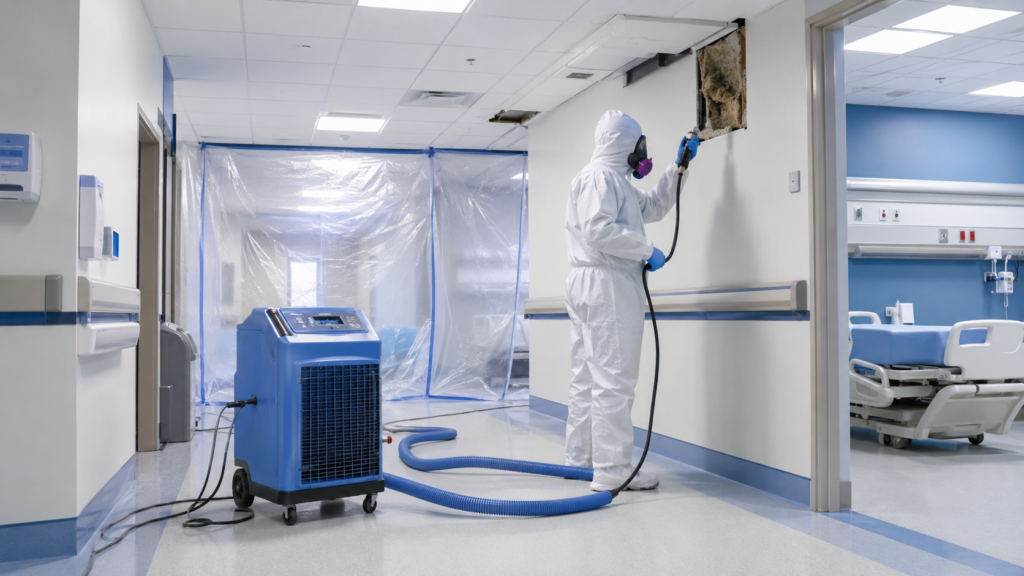
That means negative air pressure setups, sealed plastic barriers with HEPA filtration, and carefully planned entry and exit points so contaminated materials never pass through clean zones. Crews working in or near patient care areas also need to understand hospital traffic flow – where staff and gurneys move, which corridors can’t be blocked, and how to keep noise and disruption to a minimum during active treatment hours.
3. Structural Drying Has to Be Faster and More Thorough
Mold doesn’t wait for anyone, but in a healthcare setting, even 24-48 hours of unaddressed moisture is too long. A single missed damp cavity behind drywall can become a mold colony that threatens respiratory-sensitive patients weeks later.
That’s why healthcare-grade jobs rely heavily on structural drying and dehumidification with thermal imaging and moisture mapping to find hidden pockets of water other crews might miss – inside walls, under flooring, above drop ceilings where HVAC returns run. In a facility with fragile patients, “probably dry” isn’t good enough. Every reading has to be documented and verified.
4. Biohazard and Medical Waste Handling Requires Specialized Protocols
Healthcare facilities generate a category of waste that residential and even most commercial jobs never encounter: sharps, contaminated linens, and regulated medical waste. If a flood or fire disrupts a supply closet, lab, or patient room, restoration crews may need to safely remove and dispose of these materials according to state and federal regulations – not just haul them to a dumpster.
This is where medical waste disposal and biohazardous sharps removal expertise becomes essential. A restoration company without healthcare experience may not even recognize what needs special handling, which can create compliance headaches for the facility long after the visible damage is gone.
5. Odor and Air Quality Control Matter More With Vulnerable Occupants
Smoke, sewage, and mold all leave odors behind – and in most buildings, that’s an inconvenience. In a facility full of patients with respiratory conditions, weakened immune systems, or chemical sensitivities, lingering odors and poor air quality can be a genuine health hazard, not just an unpleasant smell.
That’s why thorough deodorization services – using HEPA air scrubbers, ozone treatment where appropriate, and full HVAC decontamination – are a standard part of any healthcare restoration job, not an afterthought tacked on at the end.
6. Documentation and Clearance Testing Are Non-Negotiable
Hospitals, clinics, and long-term care facilities answer to regulators, accreditation bodies, and their own infection-control committees. A restoration job isn’t finished when the space looks clean – it’s finished when it can be proven clean.
That’s why post-remediation clearance testing is such a critical final step. Independent air and surface sampling confirms that mold spore counts, bacteria levels, and moisture readings are back within safe limits before patients or staff re-enter the space. Facility managers need that paperwork on file – both to protect patients and to satisfy inspectors.
7. Speed and Coordination Can’t Compromise Patient Care
Perhaps the biggest difference between residential and healthcare restoration is logistics. A homeowner can relocate to a hotel while repairs happen. A hospital wing usually can’t simply shut down. Restoration crews working in active healthcare facilities have to coordinate closely with facility management, work around patient schedules, and often perform noisy or disruptive work in phases – nights, off-hours, or one section at a time – so the rest of the facility keeps functioning normally.
This requires genuine disaster response and recovery experience with facilities, not just homes. A crew unfamiliar with healthcare environments can unintentionally create bottlenecks that cost a facility far more than the original damage.
What Killeen Facility Managers Should Look For
If you manage a clinic, hospital department, or nursing home in the Killeen area, ask any restoration company you’re considering:
- Do they have documented experience in healthcare or medical facility environments?
- Can they show a process for infection control and containment, not just drying and cleanup?
- Do they handle biohazard and regulated medical waste in-house, or do they need to subcontract it?
- Will they provide clearance testing and documentation for your compliance records?
- Can they work around your patient census and operating hours without shutting the facility down?
A restoration crew that can’t answer these clearly probably hasn’t done this kind of work before – and a healthcare facility is the wrong place to find that out mid-emergency.
Fast, Facility-Ready Response When It Matters Most
Water, fire, and biohazard emergencies in healthcare settings demand a level of speed, discipline, and compliance awareness that general contractors and typical restoration crews simply aren’t built for. From the first hour of emergency response through final clearance testing, every step needs to protect patients as much as it protects the building.
If your Killeen-area healthcare facility needs an emergency response team that understands what’s actually at stake, our team is available 24/7 with the equipment, protocols, and experience to restore your facility safely – without compromising patient care along the way. Learn more about our full range of restoration services or see the Killeen-area communities we serve.
Leave a Reply