
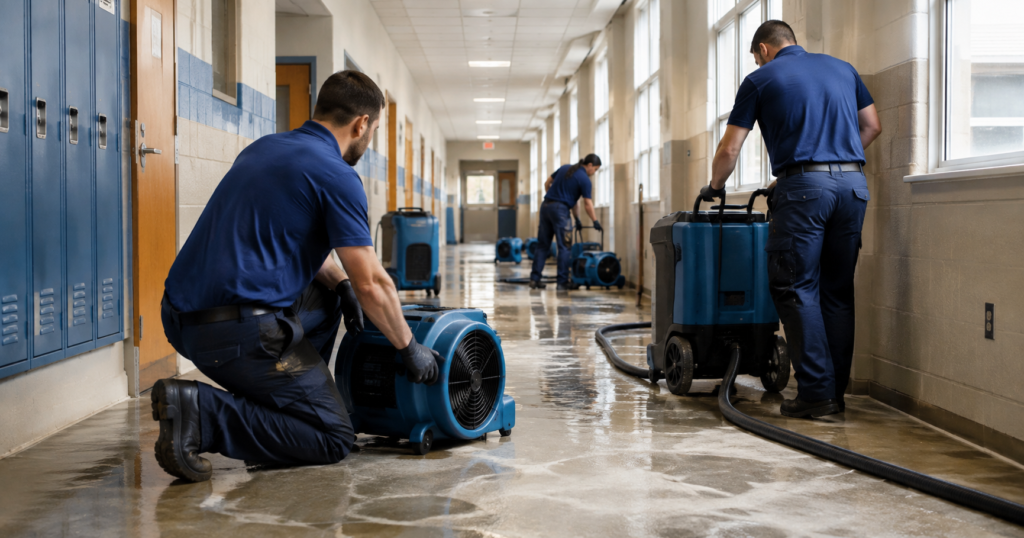
A burst pipe over a weekend. An overflowing HVAC condensate line during a Central Texas heat wave. A sudden spring storm that pushes water through a roof seam. For most homeowners, these are stressful but manageable events. For a school, they’re something else entirely – a threat to student safety, instructional time, and district budgets, all happening on a much bigger footprint than a typical home or office.
Killeen ISD and the surrounding Bell County school facilities face a unique set of water damage risks, and the response window that works for a house doesn’t scale to a 60,000-square-foot elementary campus. Here’s what facilities directors, administrators, and maintenance staff need to understand about emergency water damage response – and why the standard “call someone Monday” approach can turn a manageable leak into a six-figure remediation project.
School Damage Restoration in Killeen: What to Expect
When a school in Killeen faces sudden water damage, the response has to move faster than a typical home job – classrooms, gyms, and cafeterias can’t stay closed for weeks. Professional school damage restoration in Killeen means coordinating around class schedules, securing affected areas, and getting facilities back to code before students return.
Why Timing Matters for Emergency Response in Schools
A weekend burst pipe or an overnight HVAC leak can sit unnoticed for days in a school building, especially over breaks. The longer water sits, the more it spreads into walls, flooring, and HVAC systems – turning a one-room problem into a building-wide one by Monday morning.
Why Schools Are a Different Kind of Water Damage Emergency
Homes and small offices have a handful of rooms and a few hundred square feet of flooring to worry about. Schools have gymnasiums, cafeterias, libraries full of paper materials, science labs with sensitive equipment, server rooms running the district’s network, and dozens of classrooms – often built with materials (acoustic ceiling tile, carpet tile, drywall) that begin absorbing moisture and breeding mold within 24 to 48 hours.
Add to that the fact that schools are occupied by children for six-plus hours a day, five days a week, and the stakes around indoor air quality and mold exposure become far higher than in a typical residential job. A restoration company that treats a school like “a bigger house” is going to miss things – and those misses show up later as complaints, absences, or a much larger remediation bill once mold gets a foothold in a HVAC system serving multiple wings.
Our school damage restoration team builds every response plan around this reality: minimizing the disruption to instructional time while making sure nothing gets missed in spaces that are hard to fully inspect during a normal school day.
The First 24 Hours: What Actually Matters
When water damage hits a school, the first day sets the trajectory for the whole project. A few things matter more than anything else:
1. Stop the source, then document everything:- Whether it’s a plumbing failure, roof leak, or sewage backup, the first call should shut off the water at the source. Facilities staff should photograph affected areas before anything is moved or cleaned – this protects the district during insurance claims and helps a restoration crew scope the job accurately.
2. Get moisture readings, not guesses:- Visible water is often the smallest part of the problem. Water travels – under flooring, behind walls, into ceiling cavities above drop tile. A proper water damage inspection uses moisture meters and thermal imaging to map out exactly how far the water has spread, which is critical in a building where a leak in one classroom can affect the room next door through a shared wall cavity or HVAC return.
3. Address HVAC exposure immediately:- School HVAC systems are usually zoned to serve multiple classrooms or an entire wing from one air handler. If water reaches ductwork or an air handling unit, mold spores can spread through the system to rooms that were never physically wet. This is one of the most commonly missed risks in school water events, and it’s why HVAC mold remediation needs to be part of the initial assessment, not an afterthought two weeks later when someone notices a musty smell in an unrelated classroom.
4. Protect sensitive spaces first:- Libraries, computer labs, and server rooms need priority attention – water and electronics or paper materials don’t mix, and the loss of instructional materials or IT infrastructure adds cost well beyond the physical repair.
Why Mold Risk Is the Real Deadline
Texas humidity means mold isn’t a someday problem – it’s a 24-to-48-hour problem. In a school setting, that clock is even less forgiving because:
- Classrooms are often unoccupied over weekends and school breaks, so a Friday afternoon leak can go undiscovered until Monday morning – well past the window where mold growth typically begins.
- Carpeted classrooms, acoustic ceiling tiles, and cardboard/paper storage in supply closets are all high-risk materials for mold colonization.
- Once mold is confirmed, Texas school districts generally can’t simply paint over it or run an air purifier – proper protocols call for containment, air quality testing, and certified remediation before a room can reopen to students.
If a leak has had time to sit, don’t assume a simple dry-out will solve it. A mold inspection and testing should be part of the plan any time water damage in a school goes undiscovered for more than a day, and if mold is already visible, black mold remediation and removal needs certified containment procedures – not just a maintenance crew with bleach and a fan.
Sewage and Contaminated Water: A Different Protocol Entirely
Not all school water events are clean water. Backed-up sewer lines, cafeteria plumbing failures, or storm surge affecting ground-level classrooms can introduce contaminated (black) water, which carries real health risks for students and staff and requires an entirely different response – full PPE for crews, discarding of porous materials that can’t be sanitized, and thorough disinfection before the space is safe to reoccupy. If your facility experiences a backup, treat it as a health and safety event first: sewage backup cleanup and sanitation has to happen before any restoration work begins, and the affected area should stay closed to students and staff until clearance testing is complete.
Minimizing Disruption to the School Calendar
Districts can’t just close a building for three weeks the way a homeowner might tolerate contractors coming and going. Restoration around an active school schedule usually means:
- Phased work zones, so unaffected wings stay open while the impacted area is contained and dried.
- Off-hours scheduling for noisy equipment like air movers and dehumidifiers where possible, run overnight or over a weekend to limit classroom disruption.
- Clear reoccupancy documentation – moisture readings and, where mold was present, clearance testing results – that the district can present to parents, staff, and its insurance carrier.
This kind of phased approach matters just as much for related building systems. Water that gets into crawlspaces or foundational areas of older Killeen-area school buildings can also point to bigger structural moisture issues; in those cases pairing remediation with foundation waterproofing prevents the same water event from recurring the next time it rains.
A Local Problem, Not a Hypothetical One
Bell County sees its share of sudden, heavy spring storms, and older school buildings across Killeen – including facilities in areas like West Killeen, East Killeen, and the Highview area – carry aging roofing and plumbing that wasn’t built for the storm intensity Central Texas has seen in recent years. Facilities teams responsible for campuses along the Hwy 195 corridor or in the Southwest Bell County footprint should have an emergency restoration contact on file before an event happens – not while water is actively spreading through a hallway.
Build a Response Plan Before You Need One
The districts and private schools that handle water damage best aren’t the ones with the newest buildings – they’re the ones with a plan already in place: a designated restoration partner, a clear notification chain, and staff who know to stop the source and call immediately rather than waiting to see if it dries out on its own.
If your facility has experienced water intrusion, or you want to put an emergency response plan in place before storm season, our team specializes in school damage restoration across Killeen and Bell County, with rapid response built around keeping classrooms open and students safe. Reach out to discuss a facility assessment or get connected with our emergency response team today.
Who Should Be Called First
Facilities staff are often the first to spot damage, but knowing who to call – and how fast – determines whether the damage stays contained. Our school damage restoration team specializes in working around class schedules and campus operations, so a call doesn’t mean shutting down the whole building. A clear emergency response plan on file before anything happens saves schools both money and downtime when it does – and starts with a water damage inspection to confirm the scope before any cleanup begins. When you’re ready to put that plan in place, contact us at (254) 320-9391 to talk through your facility’s specific needs.
Leave a Reply